You are leaving girlscouts.org for a website opened by an external party. You will be subjected to the privacy and security policies of the website

A lot of people equate leadership with “being in charge” or having a title. In reality, anyone can be a leader. It’s about recognizing that you are part of a team and understanding that team’s needs and interests. Here’s how you’ll do that with your troop!
Your Role as a Girl Scout Volunteer 
Your Responsibilities as a Girl Scout Volunteer
Planning for Your First Troop Meeting
Girl Scout Troop Size
Knowing How Many Volunteers You Need
Girl Scout groups gathering in person or virtually must follow these guidelines:
- At least two unrelated, registered, background-checked adults must be present and actively supervising. Youth leaders cannot take their place.
- At least one of the adults must be female.
- The two required adults must not be related or live in the same household.
Adult supervision rules apply to all Girl Scout activities, including meetings, trip/travel, camps, events, and activities. There are no exceptions. Report any deviation from this policy to your council.
Note: Invited or additional participating adults can be related, but they cannot replace the two unrelated leaders.
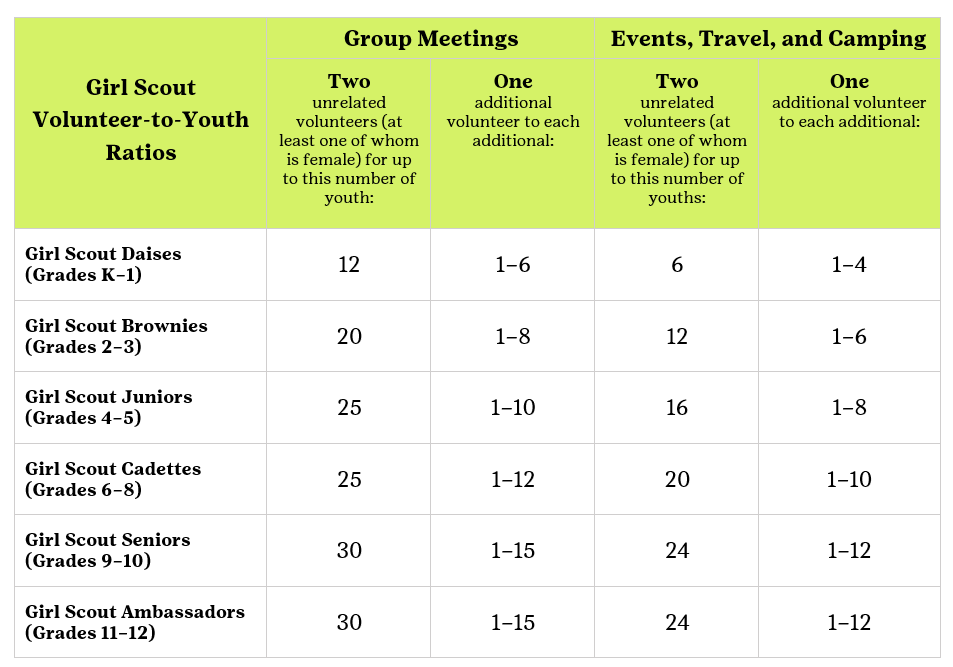
Determine the minimum number of adult chaperones needed:
- Adult-to-youth ratios vary based on participants’ ages and the type of activity.
- Group meetings require fewer adults; refer to the “Group Meetings” column in the table below.
- Outings, activities, camping, and travel require more supervision. Refer to the “Events, Travel, and Camping” column in the table.
Count all children (Girl Scouts or not) in supervision ratios unless they’re under the constant care of their own parent/guardian who is not acting as a chaperone.
Safety in Girl Scouting
Registering Girls and Adults in Girl Scouting
Creating an Atmosphere of Acceptance and Inclusion
Getting Support for Your Troop
Troop Management Tools and Resources

Forms and Documents
Here is where you'll find frequently access forms and documents to help manage your troop.
EXPLORE
© Copyright 2009–2026 Girl Scouts of the United States of America. All rights reserved. All information and material contained in Girl Scouts’ Volunteer Essentials guide (“Material”) is provided by Girl Scouts of the United States of America (GSUSA) and is intended to be educational material solely to be used by Girl Scout volunteers and council staff. Reproduction, distribution, compiling, or creating derivative works of any portion of the Material or any use other than noncommercial uses as permitted by copyright law is prohibited, unless explicit, prior authorization by GSUSA in writing was granted. GSUSA reserves its exclusive right in its sole discretion to alter, limit, or discontinue the Material at any time without notice.
